Not in Fine Linen in Genesis 2:25

The text of Genesis 2: 25 appears as follows:

From the Hebrew Bible without Vowels or Accents created by JesusSpokeAramaic

Samaritan Targum Interlinear Translation

Here’s the interlinear translation of Genesis 2: 25:

from tanakh.info

Facts About Hebrew

We can add the following to our facts about Hebrew:

157. The Shen שן Word Family is complex, having 5 different meaning streams (the rows highlighted in grey, orange, green, blue and yellow), as shown in the table below:

According to Strong’s Concordance, the following words are connected:

  • H8142 שנה that means ‘sleep’ is from H3462 ישן that means ‘sleep, grow old’ , and H8139 שנה that in Aramaic means ‘sleep’ and H8153 שנה that means ‘sleep’ are from H8142 שנה that means ‘sleep’ (shaded in gray),
  • H8127 שן that means ‘tooth’ and H8148 שנינה that means ‘sharp word taunt’ are from H8150 שנן that means ‘whet, sharpen’ (shaded in orange),
  • H8131 שנא that in Aramaic means ‘to hate’, H8135 שנא that means ‘hating, hatred’, and H8146 שניא that means ‘hatred’, are from H8130 שנא that means ‘to hate’ (shaded in green),
  • H8133 שנא that in Aramaic means ‘to change’ corresponds to, and H8141 שנה that means ‘a year’ is from H8132 שנא that means ‘to change’, and H8140 שנה that in Aramaic means ‘a year’ corresponds to H8141 שנה ‘that means ‘a year’ (shaded in blue), and
  • H8136 שנאן that means ‘repetition’and H8145 שני that means ‘second’ are from H8138 שנה that means ‘change – esp. mentally grow insane’ (shaded in yellow).

In the columns of the table above we see the following connections between the different forms of the word shen as categorized by Strong’s Concordance:

  1. The form שינא / שנא is found in words shaded in green that mean ‘hate’ (shaded in green), and ‘change’ (shaded in blue). This is confirmed by Dr. Fuerst, in his book A Hebrew & Chaldee Lexicon to the Old Testament, on p. 1416 שנא means I. The same as שנה (I) 1. ‘to change’ of gold ‘to become black’, i. e. to alter for the worse Lam 4:1 & 2, pu. ‘to be disfigured’ Eccl 8:1, Job 14:20. II. (not used) ‘to shine, to glitter, to lighten’, metaphor. ‘to be distinguished, noble’, hence of angels Ps 104:4. Also, ‘to hate’ Deut 22:13, Judges 14:16,’a hater’ i. e. ‘an enemy’ Prov 13:24, Deut 19:11, pih. ‘to hate much or constantly’ of enemies Ps 44:8, 55:13, 83:3.
  2. The form שן is found in words that mean ‘sleep, grow old’ (shaded in gray), ‘tooth’ (shaded in orange), ‘change’ or ‘year’ (shaded in blue), and ‘change’ (shaded in yellow). Dr. Fuerst provides a broader meaning for שן on p. 1416, ‘a tooth’, representing ‘an instrument with which they destroy’, ‘to gnash one’s teeth against a person, as a mark of rage’.
  3. The form שנה is found in words that mean ‘sleep, grow old’ (shaded in gray), ‘tooth’ (shaded in orange), and ‘year’ (shaded in blue). Dr. Fuerst p. 1418 שנה means I 1. ‘to fold together’ two things, ‘to double’ hence ‘to repeat, to do again’ Neh 13:21, 2. ‘to be changeable, to change’ of God Mal 3:6, ‘to be fickle’ i. e. unreliable Prov 24:21, pih. ‘to change, to alter’ garments Jer 52:33, i. e. of political direction, ‘to pervert’, i. e. to overstep Prov 31:5, ‘to disfigure’ Job 14:20, ‘to change the understanding’, i. e. = to be mad 1 Sam 21:14, Ps 34:1. II (not used) ‘to shine, to glitter, to lighten’,. Also 1. ‘a repetition, a return’ of the sun’s circuit, hence ‘a year’ Exod 23:16, Aramaic the same as Hebrew Dan 6:1, 7:1. Also ‘sleep’ a figure of laziness Prov 6:4, 20:13 and of rest Eccl 8:16, a pleasant thing Jer 31:26, also ‘sleep of death’ Ps 76:6, figurat. ‘a dreamy, torpid thing’ Ps 90:5, Aramaic the same as the Hebrew ‘sleep’ Dan 6:19.
  4. The form שני is found in words that mean ‘tooth’ (shaded in orange)(that Dr. Fuerst states on p. 1416 means representing ‘an instrument with which they destroy’, ‘to gnash one’s teeth against a person, as a mark of rage’), ‘to change’ or ‘a year’ (shaded in blue), and ‘second’ and ‘two’ (shaded in yellow). In Fuerst’s Lexicon on p. 1419 שני means a thing folded, doubled, repeated, and so dual, number two, 1. ‘the two’ Eccl 1, ‘by two’ Num 13:23, 2. ‘a pair’ Gen 6:19, 20, 7:2, ‘the double’ Exod 22:3, ‘two thirds’ Zech 13:8. Also, ‘the shining, the light-giving thing, the colour crimson’. Also, 1. ‘the second, the other’ Gen 1:8, 2. ‘of the second rank’ only Judges 6:25.
  5. Only Strong’s H3462 ישן is not categorized as other Strong’s numbers (however 3 occurrences of shen שן and 1 of שנה are classifed as H3462), indicating a connection between the words. In Fuerst’s Lexicon on p. 619 ישן means I ‘to be juiceless, weak, fading, old’, II ‘to shine, glitter, light’. Also ‘to sink down’ from exhaustion and weariness, ‘to be languid, inactive, weary’ hence ‘to sleep’ Job 3:13, metaphor. of inactivity Ps 121:4 and the sleep of death Job 3:13, pih. ‘to cause to sleep’ Judges 16:19. Also 1. ‘old, belonging to a former year’ spoken of grain Lev 25:22, metaphor. ‘old’, 2. ‘old Beth-Cor 1 Sam 7:11. Also 1. ‘sleeping’ 1 Sam 26:7, Dan 12:2 ‘the dead’, 2. ‘a shining one’ 2 Sam 23:32.

The connection between these words iis confirmed in the article ישן on Abarim Publications, which states “The forms ישן (ysn), שנן (snn), and שנה (snh) are closely related, and their meanings also appear to be in each other’s close vicinity. Then there is the verb שנא (‘sane’), which looks identical to a noun derived from the verb ישן (yashen).”  Even yashen ישן that means ‘old’, may have originally meant “withered or flabby, like a lifeless plant with top hanging down as if in sleep”, and connected to repetition in that sleep is “a singular event that is repeated every night”, and shanan שנן that means to sharpen “was done by repeatedly stroking it across a wet-stone”, related to the idea of repeating teachings or insults over and over.  Even the disparate meanings of שנה are connected to ‘change’ and ‘repeat’, and “scarlet also seemed to have symbolized the process of purification”.  https://www.abarim-publications.com/Dictionary/y/y-si-nfin.html

We discussed in the article The Real Meaning of the Numbers 1 to 7, under the heading Two or Sleep in Death, the connection between ‘a year’ (Strong’s H8140 & 8141) which is the passage of time that causes us to ‘grow old’ (Strong’s H3462), eventually falling to ‘sleep in death’ (a phrase found in Ps 13:3, 90:5 and 1 Thes 4:13), and the ‘second’ day in Gen 1: 7 & 8 when man sinned (changed, became dark), were separated from God, and subject to death.  The verses where שני is translated ‘scarlet’ were rejected for being found only in questionable text (highlighted in red in the Shen Word Family table above).  Where shen is translated ‘tooth, teeth’ it is meant in a figurative way as “an instrument with which they destroy”, often found in the phrase “gnash one’s teeth against a person”, which as Fuerst states on p. 1416 is “a mark of rage”.

Like ‘tooth, teeth’, the words ‘year’, ‘second’ and ‘sleep’ figuratively mean ‘to change’ of gold ‘to become black’, as שנא and שנה are said to mean in Fuerst’s Lexicon p. 1416 (more fully described in #1 above), “to be hateful, repulsive” as Fuerst states on p. 1417 “the stem ש may have meant originally”, having “regarded the tr. to pierce hence to hurt, to be injurious, hated as its fundamental signification”, and ‘to change’ of political direction ‘to pervert’ as שנה is said to mean in Fuerst’s Lexicon p. 1418 (more fully described in #3 above).  In Gen 2:21, we see the man’s condition was not ‘sleep’ but more likely a change to darkness, perversion; “Cast down Yahweh gods stupidity (תרדמה translated ‘deep sleep’ that Fuerst indicates on p. 1491 fig. means ‘stupidity’ in Isa 29:10 where the eyes are shut and visions concealed) upon the man and he will become dark/perverted (יישן translated ‘he slept’) . . .”. 

Looking at Strong’s H8147 in the Shen שן Word Family table above, we see that 253 of the 769 occurrences of are found in the form שתי (94 https://biblehub.com/hebrew/shetei_8147.htm , 40 https://biblehub.com/hebrew/shetayim_8147.htm , 29 https://biblehub.com/hebrew/sheteim_8147.htm , 25 https://biblehub.com/hebrew/ushetayim_8147.htm , etc.).  In Fuerst’s Lexicon On p. 1451 שתי means ‘a drinking’, ‘debachery’ generally Eccl 10:17, 2. ‘web, woven stuff’, ‘the warp’ of weavers, as well as the number ‘two’, and Strong’s has categorized 217 occurrences of  שת as H8354 that means ‘drink’, that figurately refers to drinking the cup of Yahweh’s wrath in Isa 51:17, 22, and Jer 25:16, and of wicked deeds in Prov 4:17, 26:6, and Job 15:15, 34:7.  We will further explore the word set שת in Genesis 4:19, where it is classified as H8147 and translated ‘two’ in v. 19, and classified as H8352 and translated ‘Seth’ in v. 25 and 26.

In the Shen שן Word Family table above, in one of the columns highlighted in green, we see Shen with the diminutive suffix שנון, categorized as H8150 4 times, translated ‘sharp’, found with חצ that is translated ‘arrows’, in Ps 45:5 “Your arrows sharp peoples under you fall . . .”, in Ps 120:4 “Arrows warrior sharp . . .”, in Prov 25:18 “Who club and sword and arrow sharp mighty one bears against neighbor witness false”, and Isa 5:28 “Leader arrows sharp . . .”.  According to Fuerst on p. 475 חצ means something cutting into or piercing, of wicked men’s violence in Ps 11:2, their words in Ps 64:4, a deceiver’s words in Prov 26:18.  The context that שנון is found in these verses supports the meanings discussed above.

In addition, we see shen with the following suffixes:

  • שנין is shen with the ין suffix, the yod means ‘of’ and nun means ‘their’ or ‘them’, 4 in the form שנינה classified as Strong’s H8148 translated ‘a taunt/a byword’ in Deut 28:37, 1 Kings 9:7, 2 Chr 7:20, and Jer 24:9, which fit the meaning of shen discussed above, and 3 in the form שנינו classified as Strong’s H8147 translated ‘both of us’ in Gen 31:37, 1 Sam 20:42 and Job 9:33, which fails to capture the meanings discussed above.
  • שנימו is shen with the מו suffix, 2 are classified as Strong’s H8127 translated ‘their teeth’, along with ‘gnash’ in Ps 35:16, and of God breaking “their teeth” in Ps 58:6, which fit the meaning of shen discussed above.
  • שניכם is shen with the יכם suffix that indicates possessive ‘your’, 1 is classified as Strong’s H8147 translated ‘of you both’ in Gen 27:45, which we will take a look at below.
  • ניהם is that indicates possessive ‘their’, 4 times as Strong’s H8127 – translated ‘their teeth’ in Micah 3:5 of the prophets who bite with ‘their teeth’, Ps 57:4 of lions ‘their teeth’ spears and arrows, Ps 124:6 of the blessings of Yahweh who not given us as prey to ‘their teeth’, & Num 11:33 of the body/flesh continuing between ‘their teeth’, which support the figurative meaning of ‘teeth’ as instuments with which they destroy, 1 time as Strong’s H8141 – translated ‘their years’ in Job 36:11 about their days in pleasure (טוב translated ‘good’ in Gen 1 to 3, a characteristic of the tree of knowledge in Gen 2:17) and their years, and 65 times שניהם is classified as Strong’s H8147 – translated ‘both of them’, which fails to capture the meanings discussed above. 

Taking a closer look at the verses in question, we see that many are part of historical narratives that shows evidence against being inspired text.  The main indication that a narriative is historical is the use of ab אב of ‘fathers’ in respect of fleshly ones, like in the account of Noah in Genesis 9:23, of Abraham and his offspring in Gen 22: 6 – 8, 27:45 (in v41), 31:37 (in v 29, 30, 35 & 42), and 48:13 (in v 1, 9, 15, 16, 17, 18, 19, 21), and David and his offspring in 1 Sam 2:34 (in v25, 27, 28, 30, 31), 9:26 (in v 20), 14:11 (in v1, 27), 20:11 (in v8, 9, 10, 12, 13), 23:18 (v17), 2 Sam 14:6 (v9), 17:18 (v8, 10, 23), 1 Kings 5:12 (in v15, 19), 11:19 (in v 21, 27, 33), & 2 Kings 2:7, 8, 11 (in v12).  In addition, ab אב is used of fleshly ‘fathers’ in the law for mighty ones (ish איש translated ‘man’) in Lev 20:11, 12, 13, 18 (in v 9, 11, 17, 19), leaders (nasi נשא) dedications offerings on the altar in Num 7:13, 19, 25, 31, 37, 43, 49, 55, 61, 67, 73, 79 (in v2), 12:5 (in v 14), 25:8 (in v 14, 15), in the law for mighty ones (ish איש translated ‘man’) in Deut 22:22, 24 (in v 15, 16, 19, 21, 29), and Judges 19:6, 8 (in v 2, 3, 4, 5, 6, 8, 9).  Some are about earthly covenants, such as Abraham’s covenant with Abimelech in Gen 21:27, 31 (in v27, 32), and Jacob’s covenant with Laban in Gen 31:37 (in v44), or gods (elohim  אלהים) covenant with Noah and his sons and their offspring in Gen 9:23 (in v 9, 11, 12, 13, 14, 15, 16, 17).  These verses make it appear Yahweh created us so that “shall leave a man his father and mother and be joined to his wife and they shall become one flesh” as Gen 2:24 is commonly translated, and that shen שן means ‘both’ when it means ‘teeth’ as instruments of destruction.

There are 5 occurrences of shen שניהם in Proverbs 17:15, 20:10, 12, 24:22, 27:3 & 29:13 where the context supports the meaning ‘both of them’ which is evidence against the text being inspired.

158. The ar ער Word Family has 7 major groupings (words of the same form and/or related according to Strong’s and/or NAS Concordance) as shown in the table below:

A question often asked is why the word ערום means ‘naked’ (Strong’s H6174) in Gen 2:25, then ‘crafty’ (Strong’s H6175) in Gen 3:1.  Is Strong’s Concordance correct in saying that both words are from H6191 ערם that means ‘shrewd, crafty’, from a primitive root that means ‘to be bare’ in the sense of smoothness, and ‘to be cunning’ in a bad sense, or is NAS Exhaustive Concordance correct in saying that H6174 is from H5783 עור that means ‘to be exposed, bare’?  In A Hebrew & Chaldee Lexicon to the Old Testament, p. 1093, Dr. Fuerst agrees with Strong’s Concordance, that ערום means ‘undress, bared’, from ערם I not found in the Hebrew Bible, and ‘cunning crafty’, from ערם II which in addition to ‘to spin, to devise’ cunning, means ‘to bind, to tie’ into a heap (Strong’s H6192). 

Arguably, words in form ar ער are connected to ער that means ‘adversary’ (Strong’s H6145 & H6146).  Evidence to support this is that in Gen 2:25, the Targum Onkelos has instead ער that in Hebrew and Aramaic means ‘adversary’, and ערים in Gen 3:1, and the Samaritan Targum has עסק in Gen 2:25 that on Wiktionary means ‘to be difficult, to be troublesome’ and אסטיל in Gen 3:1 that in Abraham Tal’s A Dictionary of Samaritan Aramaic p. 52 means ‘villain’.  It is likely that ar ער as a noun means ‘adversary, villain’, as an adjective means ‘difficult, troublesome, crafty’, and as a verb means ‘bare, raze, destroy, demolish, ruin, lay waste’.

Where ar ער is translated ‘prudent, shrewd, sensible, wise’ is evidence of either a mistranslation or uninspired text, as detailed below:

  1. Strong’s H6175 (11 occurrences) means ‘crafty’ in Gen 3:1 & Job 15:5 (and Job 5:12 according to KJV), or ‘shrewd, sensible’ in Prov 12:16, 23, 13:16, 14:8, 15, 18, 22:3, 27:12, (and according to NAS in Job 5:12).  Of the 11 occurrences, 3 are in the plural form ערומים, in Job 5:12, 15:5, & Prov 14:18, and 8 are in the form ערום, in Gen 3:1, Prov 12:16, 23, 13:16, 14:8, 15, 22:3, 27:12.

In Job 5:12 God “frustrates the plans of the crafty so that their hands cannot carry out their plans.”, ar ער is translated ‘shrewd’ in NASB, but the context support that the subject is crafty enemies, not ‘perceptive, insightful’ people.

In the Aramaic Bible in Plain English, Prov 12:16 is translated “A fool immediately makes his wrath known and a cunning one hides his insult.”, Prov 12:23 “A cunning man is a seat of knowledge, and the heart of fools proclaims evil.”, and Prov 14:8 “A cunning one in his wisdom understands his way, and the way of fools is in error.” In most Bible versions, the waw ו in these verses is translated ‘but’ instead of ‘and’, making it appear to contrast the cunning and fools when it is indicating similarity.

2. There are 4 occurrences of Strong’s H6191 that means ‘crafty’ in Ps 83:3, and in 1 Sam 23:22 according to most Bible versions, but ‘sensible, prudent’ in Prov 15:5 & 19:25, and ‘subtilly, clever’ in 1 Sam 23:22 according to KJB, ASV and Aramaic Bible in Plain English. Of the 4 occurrences, 2 are in the form ערם in Prov 15:5 and 19:25, 1 in the form ערום in 1 Sam 23:22, and 1 in the form ערימו in Ps 83:3.

3. There are 5 occurrences of ערמה, classified as Strong’s H6195 that means ‘craftiness’ in Exodus 21:14 and Josh 9:4, but ‘prudence’ in Prov 1:4, 8:5, 12.

The wisdom text of Proverbs, needs closer scrutiny to assess the content and translation.  It is problematic that cunning is spoken of as something desirable, possible evidence against the text being inspired. 

In the Aramaic Bible in Plain English, Prov 1:4 is translated “To give children cunning . . .”, then in Prov 8:5 “That children may understand subtlety . . .”.  The word translated ‘children’ in these verses is pthiy פת that means ‘naïve, simple’. 

It is also problematic that knowledge is spoken of as something desirable, when in Genesis 2:17, Adam was warned not to eat from the tree of knowledge (daath דעת) of good and evil, for in the day you eat from it, you shall die.

In Prov 8:12 “I wisdom (chokmah חכמה) dwell cunning and knowledge (daath דעת)  and plans (evil).” 

After Proverbs 8: 1 to 21 there is a pe פ which marks the end of a paragraph (see Fact #8), and in v. 22 to 31 wisdom is said to be used of the Messiah, however the word chokmah חכמה doesn’t occur in this paragraph.

Dr. Fuerst, in his A Hebrew and Chaldee Lexicon to the Old Testament, provides an alternate meaning for Hebrew words that are translated ‘naked(ness)’, as follows:

  1. On p. 1092 ערה means I ‘to be naked, bore, bald’ (of the body, a plain, or an empty open space), trans. meaning ‘to put off, to undress, to make bare’, pih. means ‘to uncover’, i. e. ‘to deflower’ Isa 3:17, ‘to make bare a shield’, i. e to ready for attack Lev 22:6, fig. ‘to lay bare the ground’, i. e. to destroy the ground, Zeph. 2:14 ‘for he has destroyed’, he has laid bare, hif. ‘to uncover, to make naked’ Lev. 20:18, 19, II ‘to flow, to run’, nif. ‘to pour oneself out’ of the spirit Isa 32:15, pih. prop. ‘to cause to flow or to run’ hence fig. ‘to give up, to expose, the life Ps 141:8, hif. ‘to pour out’ Isa 53:12, i. e. ‘to deliver up’, hithp. in Ps 37:25 ‘to spread out’ of a tree, ‘ to pour out, to vomit’ of the drunken Lam 4:21, III ‘to sprout thickly, to grow, to be green, Ps 37:25. Strong’s H6168 (15 occurrences) in the form ערה and ער means ‘be naked, bare’, of foundations laid bare, i. e. tearing down walls, ’empty’, i. e. removing any contents. Only in the law in Lev 20:18 & 19 does it mean literal ‘nakedness’, evidence against the text being inspired.
  2. On p. 1093 ערוה means ‘nakedness’ which one covers Ezek 16:8, fig. ‘unoccupied, accessible and undefended’ places of the land, also ‘a baring’, fig. ‘a complete emptying out, a consumption’ (of money) Ezek 4:14. Strong’s H6169 (1 occurrence) in the form ערות means ‘bulrushes’, H6172 (54 occurrences) ערוה means ‘nakedness’.
  3. On p. 1093 ערום means ‘bared, naked’ (plural of ערמים and ערומים) from ערם I that means ‘to be naked, bare’ on p. 1095. Of the 16 occurrences of Strong’s H6174 that means ‘naked’, 2 are in the plural form ערומים in Gen 2:25 and Job 22:6, 1 is in the form ערום in Micah 1:8, and 12 are in the form ערם in 1 Sam 19:24, Job 1:21, 24:7, 10, 26:6, Eccl 5:15, Isa 20:2, 3, 4, 58:7, and Amos 2:16, and 1 is in the form ערמה in Hosea 2:3.
  4. On p. 1096 ערער means 1. ‘the naked, the bare’ hence ‘the unfortunate, poor, helpless’ Ps 102:18, 2. The name of a tree that grows in the wilderness Jer 17:6, 48:6. Also 1. a Moabite city in Deut 2:36, 3:12, 2. An Ammonite city, 3. ‘a tree, a shrub’ Jer 48:6, 4. A city in Judah a Sam 30:28.

A third meaning stream for ערם (in addition to ‘bare, naked’ and ‘cunning, crafty’) in Fuerst’s Lexicon on p. 1096 is ‘to be high, to project upward, to be strong firm’ that he indicates is ‘not used’, but he has classified Strong’s H6196 ערמנים that means ‘plane/chesnut-tree’ as as עמם on p. 1066 that means ‘to be superior to, to overtop, to surpass’.  The tree in Ezek 31:8 represents these characteristics, and we noted in our study of the four rivers verses in Gen 2: 10 to 14 the alignment with the text of Ezekiel 31:5.

159.  ית is presented as a prefix to בשש and translated ‘were’ in Gen 2:25.  In Hebrew ית is not a prefix, but according to www.wordsense.eu is a suffix that indicates singular, while יות indicates plural. The prefix ית in Aramaic is a non-translatable mark like eth ית, used to introduce a direct object, indicating ‘self’, e. g. ‘myself, himself, etc’.  Strong’s H3487 (1 occurrence) in Dan 3:12 translated ‘whom’.

The Targum Onkelos has instead מי that in Fuerst’s Lexicon p. 803 is a interrog. pronoun ‘who, what’, Strong’s H4310 (422 occurrences)  means ‘who?’ of persons, ‘what, how?’. 

160.  The verb bosh בוש (Strong’s H954 113 occurrences) means ‘ashamed’, in the form בשש in Exodus 32:1 is translated ‘delayed’, and in Judges 5:28 is translated ‘so long’ in reference to time.

In Fuest’s Lexicon p 189 – 190, three major meaning streams are stated:

  1. בוש means ‘to be pale, white’ metaphor. ‘to change colour, to be ashamed’, i. e. ‘to grow pale with shame’, applied to the sun in Isa 24:23 ‘to be obscured’, of the land in Jer 51:47 ‘to be desolate’, in the form ביש in Ps 44:7 means ‘to put to shame’.  Fuerst includes יבש (Strong’s H3001 73 occurrences means ‘to be dry, withered’) found in 2 Sam 19:6 indicating it means ‘to deceive’ but translates it ‘disappoint’ in the sentence which he connects to being ashamed.
  2. בוש means ‘to be bad, hated’, pih. ‘to act viciously’, in the form בושס in Am 5:11 ‘to bring evil upon one’ (classified by Strong’s as H1318 that means ‘to trample’), hif. ביש ‘to act badly’ that in Prov 10:5 is classified by Strong’s as H954 and translated ‘causes shame’, includes יבש (Strong’s H3001 73 occurrences means ‘to be dry, withered’) that means ‘to become bad, corrupt’ in Joel 1:10, 12 & 17 and באיש (Strong’s H887 means ‘to have a bad smell, to stink’).
  3. בוש means ‘to extend’ spoken of time, hence ‘until the extension’ i. e. very long in Judges 3:25, 2 Kings 2:17, 8:11, pih. בושש ‘to extend, to delay, to tarry’ Exodus 32:1, Judges 5:28, the fundamental signification is ‘to spread, extend’ transferred to time, ‘to lengthen unduly’.

Another possibility is that בשש in Gen. 2:25 is the noun shesh שש (Strong’s 8336 41 occurrences) that means ‘byssus, fine linen’, with the beth ב prefix that means ‘in’.  In the article The Real Meaning of Numbers 1 to 7, under the heading Six or Make White, we identified that shesh שש (Strong’s 8337 215 occurrences) that means ‘six’ is from shayish שיש (Strong’s 7893 1 occurrence) that means ‘alabaster’ from an unused root that means ‘to bleach, i. e. whiten, white, i. e. marble’, and is tied to shesh שש (Strong’s 8336 41 occurrences) that means ‘fine linen’, translated as ‘marble’ in Esther 1:6 and Songs 5:15.  Fine linen (shesh שש) was Tyre’s (tsar צר means ‘enemy’) banner in Ezek 27:1 to 7, and a sign of wealth in Luke 16:19.

Another word that means ‘fine linen’ is בוץ that in Fuerst’s Lexicon p. 189 (Strong’s H948) is a fine white cotton (byssus – late) used to make clothing for kings, priests and rich men, different from the somewhat similar שש (byssus).  Fine linen (buts בוץ) was a good Babylon purchased from the merchants of the earth Rev 18:12, what the great city was clothed in Rev 18:16.

Constructing the Sentences

Let’s construct the sentence:

Gen. 2:25 The subject ‘their teeth’, verbs ‘will be’ and ‘bared’, objects ‘the man and his woman’, and adjective ‘and not whom in fine linen’.

Translation

The sentence translates as follows:

And be their teeth bared the man and his woman and not whom in fine linen.

Analysis

The translation of shen שן (see Fact #157) as ‘the two of them’ and ar ער (see Fact #158) as ‘naked’ is proven to be incorrect in analyzing their Word Families, where we see they more than likely mean ‘teeth’ and ‘bare’ respectively.

This indicates the relationship between the man and his mighty fire was hostile, which is critical to understand when we look at Genesis 3.

Also, rather than Adam and his woman being “. . . not ashamed”, it is more likely they were not “in fine linen” (see Fact #160).  This is supported by the fact that the Targum Onkelos has instead תכל, Strong’s H8502 that in Ps 119:96 means ‘completeness, perfection’, similar to the figurative meaning of ‘fine linen’.

At the marriage of the Lamb, His mighty fire (אשת translated ‘bride’) is set apart (קדש translated ‘made ready’), and bestowed (נתן translated ‘granted’) to be arrayed in fine linen (buts בוץ), pure and clean, as the fine linen is the righteousness of those set apart in Rev 19:7 – 8. 

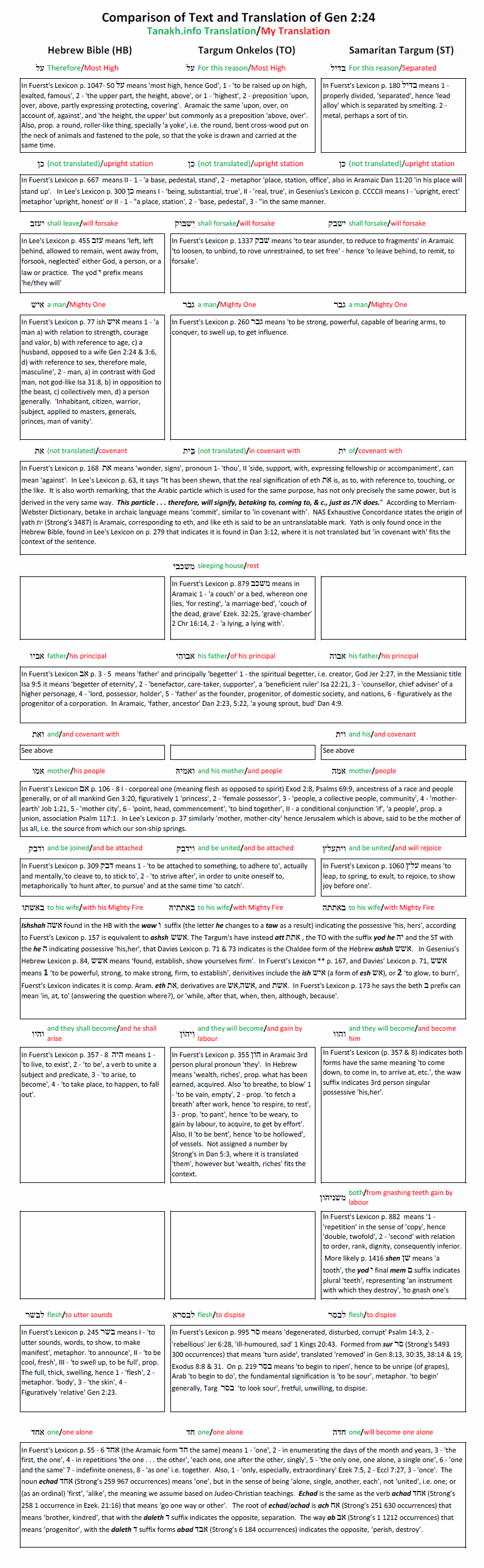
A Comparison of the Text and Translation of Genesis 2:24

The Comparison of the Text and Translation below (due to the size I was only able to add it as downloadable document), is very laborious to prepare, but at the same time it is very satisfying, because it sheds light on the meaning of the text, uncovering the real meaning of Yahweh’s words hidden in the English translation of the Hebrew Bible.

In my original analysis, I picked up on many of the words that are mistranslated in Gen 2:24, but I translated ken כן as ‘thus’, one of the meanings stated in Strong’s Concordance (see Fact #149).  I concluded that it was “used of things taking place as God commanded”, because it appeared the case in Genesis 1: 7, 9, 11, 15, 24, & 30.  I missed the fact that ken כן means ‘place, station, office’ and ‘upright, honest’ in Fuerst’s Lexicon p. 667 – 8, and did not identify the fact that ken כן is not translated, evidence of a problem with the meaning assigned by Strong’s and/or the translation of the verse.

Taking another look at these verses in Genesis 1, we see from the context that Yahweh gods is dividing, and putting things into their ‘upright place, station, office’.  God makes (as עש) the firmament in v. 7, then says (amar אמר) a change in v. 9, 11, 14 – 15, 24, 29 – 30, that in each case ends with “and was upright place (ken כן translated ‘so’)”.  In v. 7 ‘space between’ on the second day, v. 9 ‘gathered together . . . place apart’ and v. 11 ‘to kind’ on the third day, v. 14 – 15 ‘space between’ on the fourth day, v. 24 ‘to kind’, then in v. 29 – 30 plants and trees yielding seed to consume in, on the sixth day.  This supports that ‘upright station’ is the real meaning of ken כן in Genesis 1.

There are 783 occurrences of ken in the Hebrew Bible, 767 identified as Strong’s 3651 alleged to mean ‘so, thus’, from kuwn that means ‘set upright’, and 16 identified as Strong’s 3653 that mean ‘estate, office, place’, most of which do not mean ‘upright’ because they are used in reference to inanimate objects (Exodus 30:18, 28, 31:9, 35:16, 38:8, 39:39, 40:11, Lev 8:11, and 1 Kings 7:31) or Pharoah (Gen 40:13 & 41:13) who was not ‘upright’.  The following examples support that ken means ‘upright station’:

  1. 22 occurrences of ken are translated ‘correct’ on Shebanq-ancient.data where ‘upright station’ fits the context, as follows:
    • In Gen 42:11 ‘upright’ JPS Tanakh 1917 and ‘honest’ in NKJV, 19 ‘upright’ in JPS Tanakh 1917 and ‘true’ in NKJV, 31 ‘upright’ in JPS Tanakh 1917 and ‘honest’ in NKJV, 33 ‘upright’ JPS Tanakh 1917 and ‘honest’ in NKJV, 34 ‘upright’ JPS Tanakh 1917 and ‘true’ in NKJV.
    • In Num 27:7 ‘right’ in most translations, 36:5 ‘right’ in JPS Tanakh 1917 and NKJV.
    • Joshua 2:4, Judges 12:6,
    • 1 Sam 23:17, 2 Kings 7:9, 17:9,
    • Job 9:5,
    • Psalm 90:12 ‘aright’ in YLT,
    • Prov 11:19 ‘rightly’ in Young’s Literal Translation & ‘steadfast’ in JPS Tanakh 1917, 15:7 ‘right’ in YLT, Eccl. 8:10 ‘right’ in JPS Tanakh 1917,
    • Jer 8:6 ‘aright’ NKJV, 23:10 ‘right’ NKJV, 48:30 ‘right’ NKJV, & Amos 5:14 ‘upright’ fits the context.
  2. The text where ken is found is mistranslated, so must be translated one verse at a time to reveal the true meaning.  For example,
    • In Joel 2:4 “As from inspecting (translated ‘Like the appearance’) mark out (translated ‘of horses’) from examining them (translated ‘their appearance is’) and separate them (translated ‘and like swift steeds’) upright station (translated ‘so’) foundation low land (translated ‘they run’).”
    • In Ezra 10:16 “And they destroy (translated ‘and did’) upright station (translated ‘so’) my children (translated ‘the descendants’) . . .”

Translating ken כן as ‘upright station’ in Gen 2:24 reveals the Mighty One will forsake his upright station with the Most High, his covenant with his principal, and his covenant with his people, to become one apart with his Mighty Fire. 

There are a few minor differences in the Targum Onkelos, “Most High upright station will forsake Mighty One covenant with rest (not in the Hebrew Bible or Samaritan Targum) of his principal and people and be attached with Mighty Fire and gain by labour (instead of ‘and he shall arise’) in corruption (instead of ‘to utter sounds’) one alone”. 

In the Samaritan Targum, the first word is ‘Separated’ instead of ‘Most High’, it says “will rejoice with Mighty Fire’ instead of ‘be attached with Mighty Fire’, and contains ‘from gnashing teeth gain by labour’ before ‘in corruption’.

Now we are ready to compare the text and translation of Genesis 2:25 in the same way.

Names and Titles of Adam in the Genesis Creation Account

In the table below, we see the names/titles used of the male and female Adam before the separation of the female from the male in Gen 2:5 to 2:22, after the separation in Gen 2:23 to 4:1, and prophesying their reunification in Gen 1:26 & 27.

The translation of the names/titles used of Adam in the Genesis creation account is inconsistent and illogical.  There are different translations of the same word, and the same translation of different words, obviously done to support the traditional account that the female was made from the male, for the male and to cover up the corruption of the male.  For example:

  • In the Hebrew Bible, Adam and haAdam are translated as either the general term ‘man’ or the specific name ‘Adam’, and ish איש in Gen 2:23, 24 & 4:1 is translated ‘man’, but in Gen 3:16 as ‘husband’. 
  • In the Targum Onkelos (TO), instead of Adam in Gen 1:26 & 2:5, we find anash אינש (with an aleph suffix in Gen 1:26), translated ‘man’ in both cases.  Instead of ish איש in Gen 2:23 & 3:16, we find baal בעל, translated ‘man’ and ‘husband’ in the TO, just like the HB.  Instead of ish איש in Gen 2:24 & 4:1, we find geber גבר , translated ‘husband’ and ‘man’ respectively in both the HB and TO. 
  • In the Samaritan Targum (ST), instead of Adam אדם in Gen 2:5 and haAdam האדם in Gen 2:7 (2nd) & 18, we find anash אנש , translated as ‘man’ in the ST, and in Gen 2:5 & 7 of the HB, but Gen 2:18 is translated ‘Adam’.  Instead of of ish איש in Gen 2:23, 24, 3:16, & 4:1 we find geber גבר translated as ‘husband’, ‘man’, and ‘husband’ respectively (Gen 4:1 is not translated), unlike the HB where Gen 2:23, 24, & 4:1 are translated ‘man’, and Gen 3:16 is translated ‘husband’. 

The names/titles used of Adam have different meanings, and indicate changes in his physical characteristics and disposition. 

Before the separation of the female from the male in Gen 2:22, the name/title/race adam אדם (Strong’s 120) means ‘a human being, common person’, or ‘to be red’, that is “from the same as” adamah אדמה (Strong’s 127) that means ‘ground, land, soil’ (see Fact #35), which described the male/female adam as dust/dirt.  Instead of Adam, the Targum’s in Gen 2:5, and the ST in Gen 2:7 (2nd occurrence) and 2:18, have anash (Strong’s 605), in the form אינש in the TO and אנש in the ST, that means ‘to be weak, sick’.  In Fuerst’s Lexicon p. 125, anash אנש means ‘to be sick i.e. morally bad, ill, figuratively painful, dangerous’.  This provides critical information about the state of mankind when he/she was made from the ground.

After the separation, in Gen 2:23, 24, 3:16 & 4:1 the male is identified as an ish איש in the HB, a baal בעל and geber גבר in the TO, and a geber גבר in the ST.  This reveals that ish, baal and geber have a common meaning, which Rashi confirmed in Exodus 15:3 when he said “Wherever the words איש and אישך occur they must be translated by בעל; so, too, (1 Kings 2:2) ‘Be thou strong and show thyself an איש’ — a mighty person.”  This is confirmed in Fuerst’s Lexicon p. 77, 1st – plural אישי or אנש, ‘strong’ from esh אש  and אשש , like/from geber גבר.  In Fuerst’s Lexicon p. 222-5, Baal בעל means, 1st – ‘to be big, mighty, strong, master, lord’, 2nd – ‘lords of the heathen i.e. their conquerors’, and  geber גבר on p. 260 – 1, 1st ‘to be strong, powerful, capable of bearing arms, to conquer, to swell up, to get influence’, 2nd – ‘a valiant soldier, a warrior, a man of strength, particularly in opposition to God, and therefore like איש in the sense of one, every one’. 

The sixth creation day in Gen 1:26 – 31, prophecies Yahshua’s incarnation in the flesh, described in John 1:14.  In the HB and ST, gods say “We will make adam in our image, in our likeness . . .”, but instead of adam, the TO has anash אינש, that means to be sick i.e. morally bad, ill, figuratively painful, dangerous.  In Gen 1:27, the ‘sick’ adam is replaced by the perfect male, Yahshua, reunited with the female, and adam is now re-created in the image of gods.  This is the wedding feast of Yahweh’s son, to which only those with wedding clothes are permitted entry in Matthew 22: 1 – 14.

The message of the Genesis creation account is largely revealed in the changing names/titles for adam.  When adam became sick (corrupt), the female was separated from the male to save her, as Yahweh said in Gen 2:18.  The male assumed the name adam after the separation, and the female’s name became ishshahAdam identified himself as a mighty one (ish) in Gen 2:23.  He was Assyria who had become ‘lofty, exalted’ (Strong’s 1361 gabahh גבהא that we see in Fact #120 figuratively means ‘toward a ditch’) as revealed in Ezek 31: 3 – 5. 

Names and Titles of Eve in the Genesis Creation Account

In the table below, we see that the Targum’s substitute att אתת for ishshah אשה in the Genesis Creation Account. 

In Fuerst’s Lexicon p. 157, it states that ishshah is equivalent to ashsh אשש, and Davies Lexicon p. 71 & 73 indicates that att אתת is the Chaldee form of the Hebrew ashsh אשש.  In Gesenius’s Hebrew Lexicon p. 84, אשש means ‘found, establish, show yourselves firm’.  In Fuerst’s Lexicon ** p. 167, and Davies’ Lexicon p. 71, אשש means 1 ‘to be powerful, strong, to make strong, firm, to establish’, derivitives include the ish איש (a form of esh אש), or 2 ‘to glow, to burn’, Fuerst’s Lexicon indicates it is comp. Aram. את, derivatives are אשה,אש, and אשת.

In my analysis of ishshah אשה in Fact #145, I concluded it means ‘mighty toward fire’, because it is the same as ishsheh אשה (Strong’s 801 65 occurrences) that means ‘offering by fire, made by fire’, that in Numbers 28:9 has a sweet aroma to Yahweh, and the root is the noun esh אש (Strong’s 784) that means ‘a fire’, with the he ה suffix that ‘expresses the concept of movement toward’, thus ishshah and ishsheh mean ‘toward fire’.   Since Yahweh יהוה is like a consuming fire (Exodus 3:2 & 24:17), it isn’t a stretch to conclude ishshah and ishsheh mean ’mighty toward Yahweh’. 

The Lexicon’s give the traditional meaning for ishshah אשה as ‘woman, wife’, which simply identifies a female personage, and fails to encapsulate her power and close relationship with Yahweh.  This broader meaning is found in Davies’ Lexicon p. 66, where it states that ishshah אשה also means ‘to be firm’, and ‘fig. to heal’, in Gesenius’s Hebrew Lexicon p. 77-8, where it says ishshah אשה also means ‘their fire’, or ‘an offering made by fire . . . means to friendly relations betw. God & man’, or ‘support’ (אשיותיה only found in Jer 50:15 where it is translated ‘her foundation(s)/pillars’), and in Fuerst’s Lexicon p. 157, where it says that ishshah אשה also means ‘to be firm, close, firmly fitted together’.  It is obvious that both ishshah and att were translated ‘woman’ or ‘wife’ to support the traditional account that the female was created from and for the male, disquising her true nature. 

In the TO, the basic form of ishshah is אתתא in Gen 2:22, 23, 3:1, 4, 6, 13 x 2, & 15, with the aleph א suffix that in Aramaic indicates the possessive ‘our’.  When created in Gen 2:22 Yahweh gods called her ‘our mighty toward fire’, then in Gen 2:23 Adam and Satan do the same, perhaps revealing a battle for the heart of the ‘mighty toward fire’.  The ‘serpent’, Adam and Satan, claim possession in Gen 3:1, and precede to trick her into breaking Yahweh’s command to not eat from the tree of knowledge of good and evil.  In Gen 3:2, 12 & 16 the yod after the aleph in איתתא may indicate a corruption of the female (however ishshah in the ST doesn’t change form in these verses) , after which Yahweh gods call her ‘your mighty fire’ אתתך in Gen 3:17 and Adam and Eve leave the garden of Eden, no longer with Yahweh gods to provide for and protect them.

The forms in which att אתת is found in the Samaritan Targum on Tanakh.info, אתה in Gen 2:22, אתהא in Gen 2:23, אתאה in Gen 3:1, 15 & 16, are not found in any Chaldee Lexicon, and they do not match the forms found Samaritanische Pentateuch version die Genesis in der Hebraischen edited by Moritz Heidenheim, where all occurrences are in the form אתתה except Gen 3:17 which is in the form אתתך, with the possessive pronoun ‘your’, on which all the text are in agreement.  As a result, we can’t be certain whether the text should contain the possessive prefix ‘his’ in Gen 2:24, 25, 3:8, 20, 21, & 4:1, or not.

In Gen 3:20 of the HB and TO, Adam ‘called (qara קרא)’ her (ishshah/att translated ‘wife’ in this verse) ‘life-giver (chavvah חוה translated ‘Eve’)’, but in the ST, Adam ‘cried/lamented/complained (zaaq  זעק)’ her appointed name ‘life-giver’.  The word qara, makes it appear that Adam was a god, calling creation into existence the way the gods (elohim) did in Gen 1:5, 8, & 10, but zaaq reveals that Adam was upset with the females power to create life, a more likely scenario. 

From the beginning of time, the fact that females have the ability to bear offspring has caused men great angst.  Procreation – carrying on their lineage is important to many men, especially powerful ones who desire an heir, but before the advent of DNA testing, they could never be 100% certain a child was theirs – a rather dis-empowering state of affairs.

The Masoretic Text Compared to the Targum’s

In looking at the History of the Hebrew Bible, the Masoretic and Samaritan texts, it becomes apparent that there are very divergent opinions on the accuracy and reliability of all the source text of the Hebrew Bible, leaving us no option but investigate the matter for ourselves. 

Having studied the Hebrew text of Gen 1:1 to 2:24, we are in a better position to compare the text of the Targums for similarities and differences, to see if they differ from our original interpretation.  We learned some interesting facts in the History of Hebrew Language, the Hebrew Bible and the Targums, which will help us with our study going forward. 

We will use the following Chaldee Lexicons (free in pdf format on archive.org) to analyze and translate the Targum text:

  • Lee’s Lexicon, short for ‘A Lexicon of Hebrew, Chaldee, and English’ by Samuel Lee, 1840        
  • Fuerst’s Lexicon, short for ‘A Hebrew & Chaldee Lexicon to the Old Testament’ by Dr Julius Fuerst, 1885                                                                       
  • Davies’ Lexicon, short for ‘A Compendious and Complete Hebrew and Chaldee Lexicon to the Old Testament’ by Benjamin Davies, 1879                                                                                             
  • Gesenius’s Hebrew Lexicon, short for ‘Gesenius’s Hebrew and English Lexicon of the Old Testament’ translated by Edward Robinson 1907
  • Gesenius’s Chaldee Lexicon, short for ‘Gesenius’s Hebrew and Chaldee Lexicon to the Old Testament Scriptures’ translated by S P Tregelles 1857  
  • Harkavy’s Dictionary, short for ‘Students’ Hebrew and Chaldee Dictionary to the Old Testament’ by A Harkavy 1914                                                                                                            

In addition, we will consult with the books Christological Aramaic Grammar by Dr. Gary Staats, and A Short Grammar of Biblical Aramaic by Alger F. Johns, to  assist with Aramaic grammar, prefixes and suffixes.

We will begin comparing the names/titles used for the male and female in Genesis 1 to 4:1 found in the Masoretic text of the Hebrew Bible (HB), the Targum Onkelos (TO), and Samaritan Targum (ST).  We will compare the ST text found on Tanakh.info with the Samaritanische Pentateuch version die Genesis in der Hebraischen edited by Moritz Heidenheim, 1884.  Then we will incorporate the comparison of the text into our study beginning with Gen 2:25.  After we are complete Genesis 3, we will go back and compare the text of Gen 1:1 to 2:24.  

The Samaritan Targum

In his article The Samaritan Pentateuch, http://classic.net.bible.org/dictionary.php?word=Pentateuch,%20The%20Samaritan author J. E. H. Thompson presents the history of the Samaritan Pentateuch.  The Greek’s knew of the Samaritan Pentateuch in the 1st century AD – “Origen knew of it”, “Eusebius of Caesarea in his Chronicon compares the ages of the patriarchs before Abraham in the Septuagint with those in the Samaritan Pentateuch and the Massoretic Text”, and “Cyril of Jerusalem notes agreement of Septuagint and Samaritan in Gen 4:8” (I 1).  The Samaritan Pentateuch must have been written at the same time as the Targum Onkelos and Jonathon.

Thompson states in his introduction, the fact that the Samaritan community in Nablus had a “recension of the Pentateuch which differs in some respects from the Massoretic has been long recognized as important.”  The Nablus roll was examined by Dr. Mills who indicated it “has the appearance of very great antiquity, but is wonderfully well preserved” (II 1), “the Jews admit that the character in which the Samaritan Pentateuch is written is older than their square character” (II 2), it is written in the same Aramaic “in which the Jewish Targums were written, sometimes called Chaldee” (V). 

Thompson says the Samaritan Pentateuch was missing for a millennium, until 1616 when a copy was purchased in Damascus by Pietro de la Valle, in 1623 presented to the Paris Oratory, then published in the Paris Polyglot, by Morinus, a priest of the Oratory, who emphasized the difference between it and the Massoretic Text, to have the church intervene to settle which was Scripture, and a fierce controversy resulted  (I 2).  The controversy makes it challenging to find unbiased opinions about the Samaritan Targum. 

In assessing the Relation of the Samaritan Recension to the Masoretic Text and to the Septuagint (III), Thompson criticizes Gesenius’s assessment of the differences because it was “founded on the assumption that the Samaritan Pentateuch is the later” (III 1), and “the assumption of Gesenius and of such Jewish writers as Kohn that the Massoretic text is always correct due to mere prejudice” (III 1. 1 c).  He classifies the variations as being due to either accident or intention, providing examples each in the Samaritan Pentateuch, the Massoretic Text, and the Septuagint and Peshitta (III 1 1 & 2).  In his review of the hypothesises (III 2), Thompson states “One has only to compare the Samaritan, Septuagint and Massoretic Text of any half a dozen consecutive chapters in the Pentateuch to prove . . . neither is dependent on the others.” 

Thompson provides a list of recommended books on the Samaritan’s and the Samaritan Pentateuch, all of which can be found in pdf on Archive.org:

  • The Samaritan script is found in the Paris and London polyglots.  Walton’s text in the London Polyglot is transcribed in square characters by Blayney, 1790.  (See the paragraph below which contains Abraham Tal’s concern about amendments made by Walton to the Samaritan text published in the London Polyglot in 1657.) 
  • Three Months’ Residence at Nablus and an Account of the Modern Samaritans by Rev. John Mills, 1864.
  • Fragments of a Samaritan Targum by Nutt, 1874.
  • The Samaritans, the Earliest Jewish Sect by J. A. Montgomery, 1907.
  • The Samaritan Pentateuch and Modern Criticism by J. Iverach Munro, 1911.

In Abraham Tal’s rendering of the event in The Samaritan Targum to the Pentateuch, Its Distinctive Characteristics and Its Metamorphosis, he confirms the Samaritan Targum was found by Pietro della Vale in the Samaritan community of Damascus, who brought it to Rome in 1616, and nearly 30 years later, in 1645, it was published by Morinus in the sixth volume of the Paris Polyglot.  Since this agrees with Thompson’s account, we can be fairly confident this information is accurate.

In the same paper, Tal alleges that Walton made many amendments to the Samaritan text published in the London Polyglot in 1657, and Walton’s text was used in the Das samaritanische Targum zum Pentateuch published by A. Brull, even though it had been copied in 1514, after Aramaic was no longer spoken in the Samaritan community, and the scribes unfamiliar with the language of the text.  These charges are addressed in the Memoirs of the Life and Writings of the Right Rev. Brian Walton, D. D. (1821) which includes Dr. Walton’s Own Vindication of the London Polyglot which is available on archive.org (in pdf) or purchased for a reasonable price from Amazon.  Given the differing opinions, we must test the text and come to our own conclusions, but this is always the case regardless.

That biased opinions exist about the Samaritan text should come as no surprise, since the conflict between the Jews and the Samaritans may go back to “the time of Judges (1100 – 1025 BCE) . . . the beginning of the Samaritan Schism” according to David Steinberg in The Origin and Nature of the Samaritans and their Relationship to Second Temple Jewish Sects.  Steinberg reveals that the foundation of their conflict is their common heritage with the Samaritan’s considering themselves to be direct descendants of the line of Aaron, whereas the Jews consider the Samaritans to be gentiles.

The conflict between the Jews and Samaritans is evident  in the New Testament.  The Jews had a negative attitude towards Samaritan’s, even accusing Yahshua of being one in John 8:48.  The Samaritans did not receive Yahshua on his way to Jerusalem because he was a Jew in Luke 9: 51 – 56.  Both Jews and Samaritans were conditioned by their priests and leaders to hate and avoid contact with each other.

It is a sin to show favouritism James 2:9, God does not show favouritism Acts 10:34, all are equal before Yahweh Gal 3:28.  In his parable of the ‘good Samaritan’, Yahshua spoke of a Samaritan showing mercy for a man who had been robbed and beaten, and he commanded his disciples to ‘do the same’ in Luke 10: 30 – 37.  When Yahshua healed ten lepers, only a Samaritan, a foreigner, returned to thank him, to whom it said “your faith has made you well” in Luke 17: 11 – 19.  A Samaritan woman was surprised when he spoke to her at a well, asking her to give him a drink, and he said if she asked, he would have given her ‘living water’, and revealed himself to her as the prophesied Messiah in John 4: 7 – 29.  Yahshua showed no favouritism based on nationality or gender, and we must follow his example. 

The Targum Onkelos

According to Wikipedia’s article Targum Onkelos, although authorship  is often attributed to ‘Onkelos’, many scholars believe it was Aquila of Sinope, who made the Greek translation before he converted to Judaism, then wrote the aramaic translation called the Targum Onkelos in the 1st century or early in the 2nd century, under the direction of Rabbis Yehoshua and Eliezer.  Some of the language dates to the late 4th and early 5th centuries, because it underwent “its final redaction” at that time.

The article states the “Onkelos’ Aramaic translation of the Pentateuch (Five Books of Moses) is almost entirely a word-by-word, literal translation of the Hebrew Masoretic Text”.  A strange way of stating the relationship between the text since the Onkelos was written centuries before the Masoretic text.  The Targum Onkelos contains supplemental material in the form of aggadic (non-legalistic exegesis) paraphrase to minimize ambiquities and obscurities, usually where the original Hebrew contained an idiom, homonym or metaphor which could not be understood otherwise.  For example, the translator replaced ‘human-like’ characteristics of God, for example “my face” is replaced with “from before me” in Ex 33:23, and “beneath his feet” is replaced by “under his throne of glory” in Ex 24:10, but as we have discovered in our word studies to-date, the Hebrew text has a broader meaning that is deficient in English translations. 

The article lists 25 “more notable changes”, of which the 4 below impact our study of Gen 1 – 3:

  • Genesis 1:2 Aramaic: וְאַרְעָא הֲוָת צָדְיָא וְרֵיקָנְיָא, in Hebrew characters [= “…and the earth was devastated and empty”], instead of “…and the earth was without form and void.”
  • Genesis 2:7 Aramaic: הות באדם לְרוּחַ מְמַלְלָא, in Hebrew characters [= “…and it became in man a speaking spirit”], instead of “…and man became a living soul.”
  • Genesis 3:5 Aramaic: וּתְהוֹן כְּרַבְרְבִין, in Hebrew characters [= “…and you shall be like potentates”], instead of “…and you shall be like gods.”  Explained in Reference 25 “The literal words used in the Hebrew text are: ‘and you shall be like elohim.’ The word elohim, however, is a Hebrew homonym, having multiple meanings. It can mean either God, angels, judges, potentates (in the sense of ‘rulers’ or ‘princes’), nobles, and gods (in the lower case). In most English translations of Genesis 3:5 it is rendered as “gods’ (in the lower case), and which, according to Onkelos, is a mistranslation and should be translated as ‘potentates’.”
  • Genesis 3:15 Aramaic: הוּא יְהִי דְּכִיר מָה דַּעֲבַדְתְּ לֵיהּ מִלְּקדְמִין וְאַתּ תְּהֵי נָטַר לֵיהּ לְסוֹפָא, in Hebrew characters [=”…he (i.e. Eve’s offspring) shall remember what you (i.e. the serpent) did to him at the beginning, but you (i.e. the serpent) shall hold it against him at the end”], instead of “he shall bruise your head, and you shall bruise his heel.”

The change to Gen 1:2 and many others are mentioned in the Raymond Apple’s Book Review of Onkelos on the Torah: Understanding the Bible Text in the Jewish Bible Quarterly.  In Gen 1:14 ‘for ancient days’ becomes ‘for counting days and years’.  Apple discusses at great length the fact that throughout the Pentateuch, elohim is changed to YHVH, with the exception of Gen 1:27 where the phrase “in the image of God” was too well known to be altered, and where a pronoun is attached to elohim, such as ‘our God’. 

We see in the explanation of the rabbinic exegesis about the two names of God, their lack of understanding of the Messiah’s position in the God head from the beginning of time, which they change to suit their doctrine.  Anthropomorphisms are avoided by replacing “God did” with “the word or glory of God did”, and passive “it was done before God”, except in Gen 1:26 it is left as “let us make man in our image”, again because this verse is too well known.   Unfortunately, what resulted was an inconsistent mix of redaction for similar words, making the Targum Onkelos a translation of questionable value.

The Massoretic Text

In his article What Is the Masoretic Text?  The Beginners Guide, author Ryan Nelson opens with “Most Jews and Protestants consider the Masoretic Text the authoritative Hebrew Bible . . . written sometime between the seventh and tenth centuries AD . . . most English translations of the Old Testament are based on the Masoretic Text”.  Nelson’s states that the Masoretic text “was based on the meticulously preserved oral tradition and the best available manuscripts of the original Hebrew text”.

By Nelson’s account “manuscripts of the Hebrew Bible were lost in the destruction of the second temple in 70 AD, so the rabbinic community began transcribing the oral tradition”, and “about a millennium before the Masoretic text was finished, rabbis began notating the original Hebrew with punctuation and additional letters to help readers correctly interpret the text”.  He states that “the Mishnah preserved the oral tradition in written form”.

According to Nelson, “by the ninth century . . . a popular Jewish sect known as the Karaites (‘readers’) was advocating for Jews to abandon the rabbinic tradition and read the ‘unadulterated’ (or rather, uninterpreted) Hebrew Bible . . . to save the Hebrew Bible . . . the Masoretes  produced a new copy . . . they used rabbinic tradition to add the most intricate system of punctuation and stress marks anyone had ever seen . . . so there could only be one way to read and understand it; the same way rabbis had for centuries.” 

Nelson makes this all sound perfectly wonderful, however as Katharine Bushnell stated in her book God’s Word to Women, “when we speak of the Bible as inspired, infallible and inviolable, we do not refer to our English version, or any mere version, but to the original text . . . written without any spaces between words in totally different looking letters from those we call ‘Hebrew’ at the present time; and the language as first written contained no vowels.” (#5). 

As Bushnell explains “Hebrew . . . was practically a ‘dead language’ as early as B. C. 250 . . . in the absence of expressed vowels, its pronunciation was likely to become lost.  So the Scribes took four consonants, ‘a h w and j’ and inserted them into the text to indicate vowel sounds . . . (that) in the end led to confusion” (#6).  She considers these changes to be “uninspired” (#7), added by Jews who were “bitter opponents of the teachings and of the spirit of Christianity”, and “held women in utter contempt” (#8).  She demonstrates how “the Word might be changed into insipid nonsense, perhaps, by the manipulation of two or three consonants of a vowel less language” in #9 – 15.

According to the British Library, the first complete printed text of the Mishnah was compiled around 200 by Judah the Prince, becoming the earliest authoritative body of Jewish oral law, containing the teaching of rabbinic sages.  The Mishnah supplements the Torah which are the first five books of the Hebrew and Christian Bibles, that form the basis of Jewish written law.  Around 500 AD the rabbis added the Gemara (‘sea’ of learning) to the Mishnah called the Talmud (‘teaching’).  https://www.bl.uk/collection-items/first-complete-mishnah

That the Jewish law was compiled by a man with the title ‘prince’ could only mean the Sanhedrin had been reestablished, after being destroyed along with the temple in 70 AD.  According to the Jewish Virtual Library, the Sanhedrin had been the supreme religious body in Israel before the destruction of the temple, headed by a president, title ‘prince’, and vice president, titled ‘father of the court’, with 69 sages, to total 71 members, which according to Hellenistic sources, the Sanhedrin was a political and judicial council headed by the country’s ruler.

The fact that the Sanhedrin, the very people who had Yahshua put to death, are the authors of the Massoretic text of the Hebrew Bible, is very disturbing.  Bushnell’s claim that they were “bitter opponents to the teachings and spirit of Christianity” is all the more poignant.  Yahshua rebuked the Scribes and Pharisees, saying that Isaiah prophesied about them teaching as doctrine the precepts of men, nullifying, disregarding, seting aside the word of God for the sake of their tradition in Matt 15: 1 – 9 and Mark 7: 4 – 13, and he said “you are of [your] father the devil, and you want to do the desires of your father.  He was a murderer from the beginning, and does not stand in the truth because there is no truth in him.  Whenever he speaks a lie, he speaks from his own [nature], for he is a liar and the father of lies.” John 8:44.

In a University of Calgary writeup on the Mishnah, it states “Mishnah can refer in a general way to the full tradition of the Oral Torah, as formulated by the Rabbis in the first centuries of the Common Era”, confirming it was “compiled by Rabbi Judah the ‘Prince’, before his death around 217 C.E.”  However, it contradicts “to a view that appears in many histories and introductions” that the traditions were written down, “but merely determining and organizing of a fixed text that was subsequently disseminated by memory”, likely because, as Nelson stated, it was “a forbidden project: transcribing the oral tradition.”  https://people.ucalgary.ca/~elsegal/TalmudMap/Mishnah.html

The New World Encyclopedia (NEW) states the Massoretic text (MT) is “the Hebrew text of the Jewish Bible (Tanakh)’, also used in Protestant Bibles, and in recent decades Catholic Bibles.  The MT was copied, edited, and distributed by a group of Jews known as the Masoretes between the 7th and 10th centuries AD.  The Hebrew word mesorah refers to the transmission of Jewish tradition, including the markings of the text and marginal notes in manuscripts of the Hebrew Bible.  The MT has numerous differences compared to the Septuagint (and the Samaritan Targum as we discuss in the section below).  https://www.newworldencyclopedia.org/entry/Masoretic_Text 

According to NEW, the Hebrew word masorah (מסורה, alt. מסורת) is “taken from Ezekiel 20:37 and means originally ‘fetter’.  The fixation of the text was considered to be in the nature of a fetter upon its exposition.  When, in the course of time, the Masorah had become a traditional discipline, the term became connected with the verb (‘to hand down’), and was given the meaning of ‘tradition’”.  But looking at masoreth and related words below, I believe it means ‘taking captive with false instruction’.

The word masoreth מסרת (Strong’s 4562 1 occurrence) means ‘bind, gird, harness, hold’, used in Ezek 20:37 in the context of Yahweh using the rod to bring Israel into the bond (masoreth) of the covenant, but there is evidence against this text being inspired.  The root asar אסר (Strong’s 631 70 occurrences) means ‘to tie, bind, imprison’, found in Isa 61:1 prophesying the Messiah who will “. . . proclaim to the captive’s liberty and to imprisoned (asar אסור) opening of the eyes/prison (peqach-qoach  פקח קוח).”  The root masar מסר (Strong’s 4560 2 occurrences) means ‘commit, deliver’, from a primitive root that means ‘to sunder, set apart, or apostatize’ – apostatize means ‘renounce religious or political belief or principle’, or mosar מסר (Strong’s 4561 1 occurrence) means ‘instruction’. 

History of the Hebrew Language, the Hebrew Bible and the Targum’s

In his Ancient Hebrew Timeline, Jeff Benner parallels Biblical events, alphbets, inscriptions, Hebrew Bible’s, and Translations https://www.ancient-hebrew.org/biblical-history/ancient-hebrew-timeline.htm.  Benner’s timeline reveals early Semitic (Hebrew)  was pictographic, and evolved into Paleo-Hebrew (middle Semitic) that resembled the Phoenician alphabet, and was used by Israel until the Babylonian exile in the 6th century BC, when it evolved into Aramaic (late Semitic script).  The Greek adopted the middle Semetic alphabet in the 10th century BC, that evolved into the modern form in the 9th century BC, and in the 4th century BC Jewish scholars translated the Torah into Greek, known as the Septuagint. 

In Benners Ancient Hebrew Timeline, he states “The Hebrew language ceases as their native language (135 AD).”  In the 1st century AD, the Torah was translated into Aramaic, named the Targum Onkelos after its alleged author, and the prophets were translated into Aramaic by Jonathon Ben Uziel, named the Targum Jonathon.  In the 2nd century AD, the writings and prophets were translated into Greek, in the Septuagint.  In the 3rd century AD, the Talmud was written in Aramaic (the Late Semitic script) and the Hebrew Bible and the New Testament were translated into Aramaic, titled the Peshitta, and translated into Latin by Jerome (the Vulgate) in the 5th century AD.  In the 7th century AD, the English language adopted the Roman alphabet.

Benner indicates that vowel pointings were added to the Hebrew (Modern Semitic) in the 10th century AD, and the oldest known Hebrew Bible was written in modern Hebrew by the Jewish Masorites.  In the 15th century AD, the Gutenburg Bible became the first Bible, a copy of the Latin Vulgate, printed on moveable type, and in 1611 the King James Bible was published.  In the 19th century AD, Eliezer Ben-Yehuda started a revival of the Hebrew language, which became the official language of the newly established state of Israel in 1948.

Steve Rudd divides the history of the Hebrew language into four periods based on the evolution of the alphabet https://www.bible.ca/manuscripts/Septuagint-LXX-Hebrew-ancient-earliest-writing-Bible-scripts-alphabets-origin-Mosaic-heiroglyphic-Paleo-Aramaic-Masoretic-Jewish-Greek.htm.  First, Joseph borrowed 22 Egyptian hieroglyphic symbols as the character alphabet for each sound in the Hebrew language called hieroglyphic Hebrew (Abstract).  Second, the 22 letters were simplified into “Paleo-Hebrew” in the time of Samuel, which was used until the Babylonian captivity (Abstract).  Third, Aramaic Hebrew was adopted, “derived from the Hebrew alphabet they replaced” (#9).  After Hebrew went extinct about 300 BC, a fourth Hebrew alphabet was invented by the Masoretes in 600 – 900 AD that added vowels, known as ‘Masoretic Hebrew’ (Abstract). 

There is consensus among religious scholars and historians that Jesus and the Apostles spoke Aramaic, and whether he knew Hebrew or not is debatable.  According to Steve Rudd, at the time of Jesus, the Jews in Judea spoke Aramaic (not Hebrew) and Greek was the language of commerce (Abstract).  Britannica contradicts itself, stating that Aramaic replaced Hebrew as the language of the Jews as early as the 6th century BC, confirming that the books of Daniel and Ezra are written in Aramaic, and the Babylonian and Jerusalem Talmuds, yet claims that Hebrew remained the language of religion, government and the upper class.  Wouldn’t scripture have been written in Hebrew if this was true?

There are contradictory claims about the extinction of the Hebrew language, but the evidence supports that when the nation of Israel went into captivity in Babylon, Hebrew fell into disuse and was replace by Aramaic Hebrew, which is the language the Targums were written in.

In the next article we will take a closer look at the the history of the Massoretic text, for a fuller understanding of it’s history, language, to assess it’s reliability.  Then we will do the same for the Targum Onkelos and the Samaritan Targum.

The Story of Eve and Misogyny

Recognizing that the men in control of scripture have twisted it to elevate themselves to gods while reducing woman to inferior, evil beings has been an awakening for me. 

In her article Genesis From Eve’s Point of View, Pamela Milne (written over 30 years ago on March 26, 1989) talks about the negative impact the story of Eve has had on women throughout history, having “ been interpreted in patriarchal and even misogynist ways by male bible scholars and theologians”, to support that women are “the devil’s gateway . . . the unsealer of that forbidden tree . . . the first deserter of the divine law . . . (who destroyed) God’s image, man.” (Tertullian),  “helper of less importance” (Ambrose), “misbegotten males” (Thomas Aquinas), that justified “persecuting women as witches” in the 15th century, and “a wife who is not properly subordinate”.

Milne talks about monumental work of Phyllis Trible of Union Theological Seminary in the 1970’s to reinterpret the Eve-Adam story.  Trible made some important arguments that we can and must build upon:

1. That Adam need not necessarily be thought of as male . . . the Hebrew text presents us with a word-pay: ha-‘adam’ (“earth creature”) is created from the earth, ha-‘adamah’, and remains basically sexless until the differentiation of female from male occurs in Genesis 2: 21 – 23, only with the advent of sexuality does the term ha-adam acquire the secondary meaning “male”; but even then is an ambiguous term.

2. The serpent speaks only to Eve, which ‘Church fathers’ interpret to mean that the woman is morally weaker than man thus an easier prey, that woman is simpleminded, gullible, untrustworthy; or that she is more sexual and her sexuality is used by the serpent to ruin the man, which is mere speculation. Eve’s “temptation” of Adam is not actually present in Genesis but has been read into the text by commentators.

3. Adam’s specific naming (and implied dominion) of Eve – – after the Fall – – is actually a consequence of sinfulness.

Milne is disappointed that Trible’s ideas “have been almost entirely ignored by mainstream biblical scholarship”, but is it a realistic to expect the Church and the world to change what has existed since the beginning of time?  After all, we can only change ourselves.  A better goal is to come to the truth through study of scripture with the guidance of the spirit of truth who proceeds from the father John 15:26 & 16:13, knowing that the world cannot receive it because it does not see it or know it John 14:17.

We must accept that we will not change the way the Genesis Creation account is understood by the masses because they have been brainwashed into believing Satan’s lies.  He offers males dominion in the kingdom’s of the world if they worship him, an offer that Yahshua refused saying “You shall worship the Lord your God and serve him only” in Luke 4: 1 – 13. Through his suffering and death Rev 5:6, he become the perfect husband for his bride, the saints in the New Jerusalem Rev 21:2.

That is why the world is in the mess it’s in today with rampant greed and violence and why we must “seek first the kingdom” as Yahshua said in Matt 6:33. We must “enter through the narrow gate, for the gate is wide and the way is broad that leads to destruction, and there are MANY who enter through it.  For the gate is small and the way is narrow that leads to life and there are FEW who find it.” in Matt 7: 13 – 14.

Godspeed!